2027's new syllabus means all old physics resources are no longer relevant. This guide breaks down what changed, and what you can do to prepare.
Author
Cognito Physics Team
For physics students in the class of 2028 and beyond, the past papers, textbooks, and tutoring centre resources available today were all written for the old syllabus and are no longer relevant.
Read this guide to learn how to avoid the common traps and be best prepared. The new course starts with Year 11 in 2027, and the first HSC exam on this syllabus will be sat in 2028.
For the big picture across Maths, Physics and Chemistry, including which year groups are affected, start with our general guide to the new syllabuses.
Overview
Key dates
Term 1, 2027: Year 11 starts the new Physics course.
Term 4, 2027: Year 12 starts the new course.
2028: first HSC Physics exam on the new syllabus. No past papers exist for this syllabus.
If you sit the HSC in 2028 or later, you will be assessed on the new syllabus. Students sitting the HSC in 2027 are assessed on the old syllabus for their entire course.
Modules become focus areas
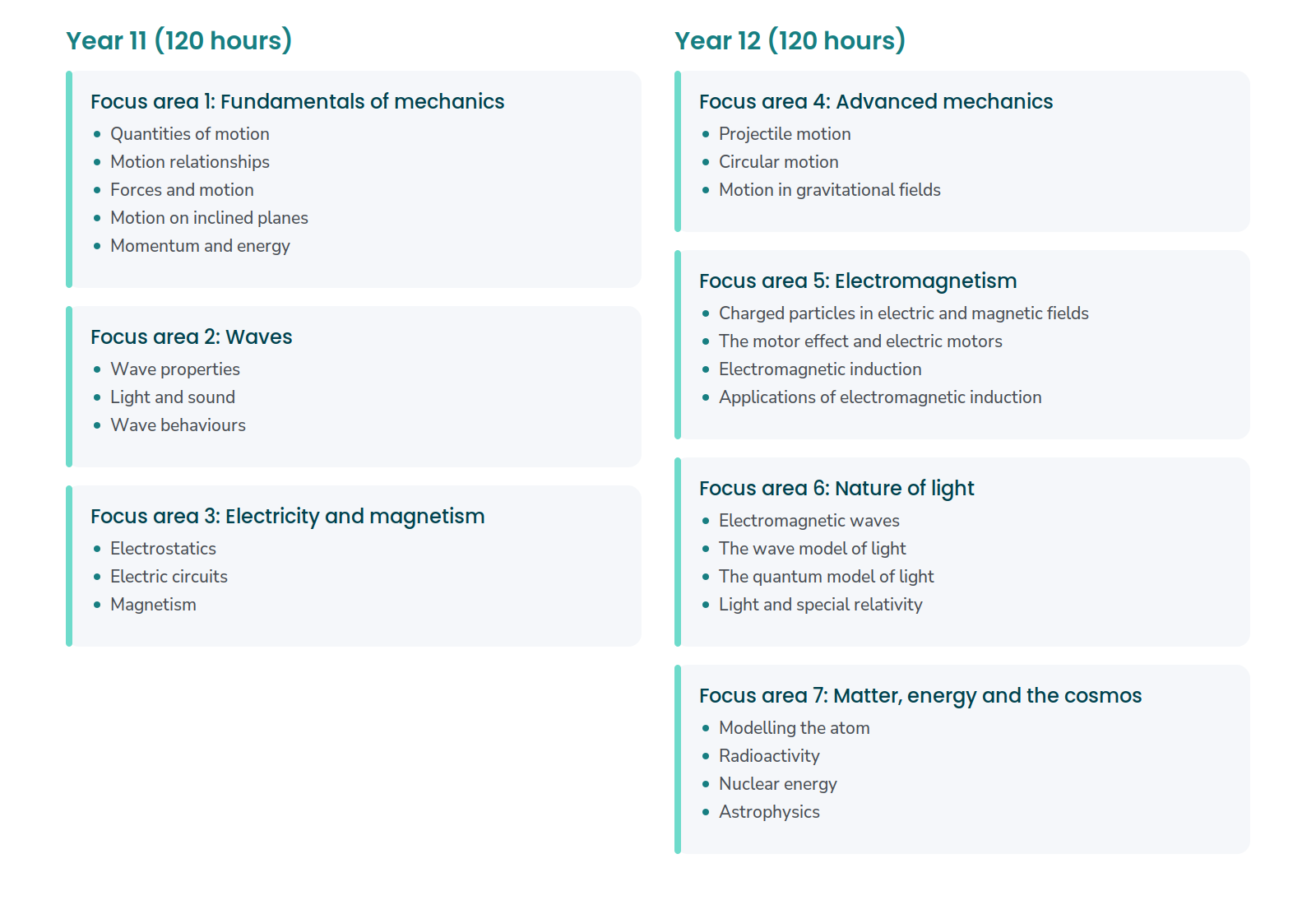
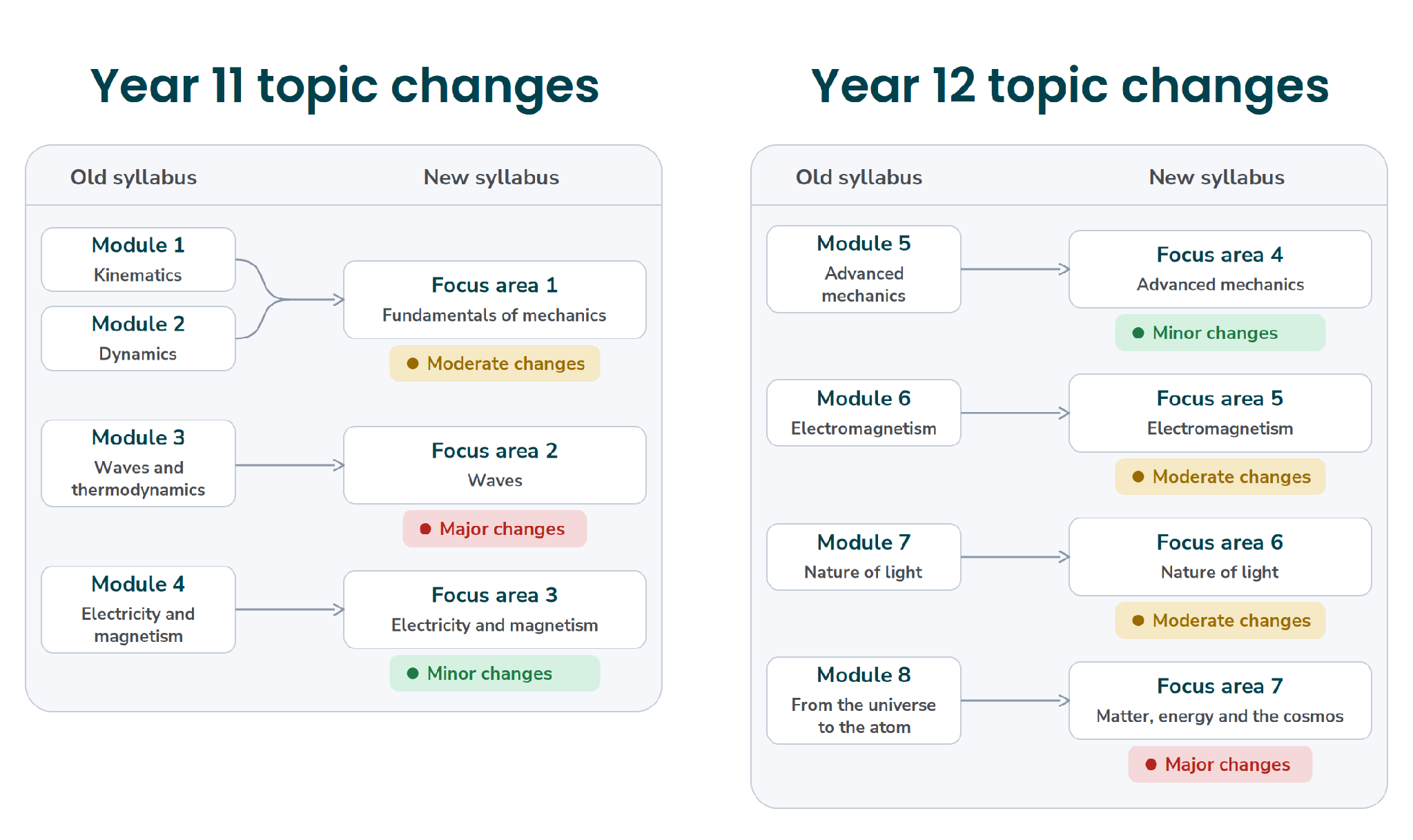
The old syllabus (Physics Stage 6, 2017) has 8 modules. The new syllabus (Physics 11–12, 2025) has 7 focus areas: 3 in Year 11 and 4 in Year 12.
Time by topic. The old syllabus allocated 60 hours to each pair of modules. The new syllabus allocates specific hours to each focus area:
Fundamentals of mechanics (Year 11): 50 hours
Waves (Year 11): 35 hours
Electricity and magnetism (Year 11): 35 hours
Each Year 12 focus area: 30 hours
Students are still required to complete at least one depth study per year, but the time allocated to depth studies drops from 15 hours to 10 hours per year. The old minimum of 35 hours of practical work is replaced by specific scientific investigations written into the syllabus.
Major changes. Inquiry questions are no longer used to group syllabus dot points. Fewer laws and scientists are named explicitly. Thermodynamics has been removed from the syllabus. Aboriginal and Torres Strait Islander knowledge moves from a general priority into specific content dot points in four focus areas, and into the Working scientifically skills.
Focus area breakdown
Content changes by focus area
For each focus area, the left column lists what is new and the right column lists what was in the matching old module but is no longer assessed. Content that moved between areas is noted in both places. The codes in brackets are our reference numbers for the new syllabus dot points (outcome, subtopic, dot point).
Focus area 1: Fundamentals of mechanics
Old Modules 1 and 2: Kinematics, Dynamics
Show content changes
Added in the new syllabus
A laboratory experiment to compare 2 methods of graphically determining a value for acceleration due to gravity and assess the accuracy and reliability of the experimental results. (PY-11-01.2.5)
The use of free-body diagrams to solve force problems is now explicitly mentioned. (PY-11-01.3.2)
Force problems involving connected bodies (in physical contact and linked by ropes) are now explicitly required. (PY-11-01.3.9)
Motion on inclined planes has been expanded into an entire topic rather than just a single dot point. (PY-11-01.4) New focuses specifically include:
Deriving the formula \(a = g\sin\theta - \mu g\cos\theta\) (PY-11-01.4.4)
The use of inclined planes to move heavy objects by Aboriginal and/or Torres Strait Islander Peoples. (PY-11-01.4.6)
A comparison of conservative and non-conservative forces. (PY-11-01.5.1)
Removed from the old syllabus
Mechanical power, including formulas such as \(P = Fv\cos\theta\). Power calculations have been moved to Focus area 3.
Impulse is no longer mentioned by name and is instead referred to as change in momentum.
Focus area 2: Waves
Old Module 3: Waves and Thermodynamics
Show content changes
Added in the new syllabus
The use of wave velocity and wavelength of water waves by Aboriginal Peoples to approximate water depth. (PY-11-02.1.7)
A greater emphasis on light as an electromagnetic wave, incorporating concepts previously introduced in Year 12, including:
The production of electromagnetic waves. (PY-11-02.2.6)
The use of formulas such as \(E = hf\) and \(c = f\lambda\). (PY-11-02.2.7)
Experiments to demonstrate:
The relationship between the frequency and pitch, and amplitude and loudness of a sound wave. (PY-11-02.2.3)
The relationship between the energy, frequency, and amplitude of a sound wave. (PY-11-02.2.4)
The relationship between light intensity and distance from the light source. (PY-11-02.2.11)
The use of wavefront diagrams is explicitly mentioned. (PY-11-02.3.2)
A focus on blueshift and redshift when studying the Doppler effect. (PY-11-02.3.19)
An investigation into how spectacles assist people with vision impairment is included. (PY-11-02.3.11)
Removed from the old syllabus
The entire topic of thermodynamics has been removed.
The scope of sound waves has been reduced, with sound wave properties including resonance and beats no longer included.
Standing waves in pipes and the harmonics formed are no longer included.
Relating the fundamental frequency of a standing wave to the length, mass, or tension of the medium.
Constructing ray diagrams for lenses.
The dispersion of light.
Focus area 3: Electricity and magnetism
Old Module 4: Electricity and Magnetism
Show content changes
Added in the new syllabus
The role of static electricity in a lightning strike. (PY-11-03.1.4)
The formula for electric field strength \(E = \frac{1}{4\pi\varepsilon_0}\frac{q}{r^2}\) (PY-11-03.1.5)
Expanded dot points on the work done and changes in kinetic and potential energy in electric fields. (PY-11-03.1.11–16)
A comparison of direct and alternating current. (PY-11-03.2.4)
Relating the resistance of a conductor to its material, length, cross-sectional area, and temperature. (PY-11-03.2.6)
A discussion on why ammeters are placed in series and voltmeters are connected in parallel in circuits. (PY-11-03.2.15)
Investigations on the materials used in electromagnets and examination of factors affecting the strength of electromagnets. (PY-11-03.3.7–8)
Removed from the old syllabus
Electric dipoles and equipotential lines.
Kirchhoff's Laws are no longer named explicitly, and a variation of the current law and voltage law is given in the new syllabus.
The comparison of the forces produced by magnetised and ferromagnetic materials.
Focus area 4: Advanced mechanics
Old Module 5: Advanced Mechanics
Show content changes
Added in the new syllabus
Projectiles used by Aboriginal and/or Torres Strait Islander Peoples. (PY-12-01.1.5)
What happens to the motion of an object that was in uniform circular motion after the centripetal force is removed. (PY-12-01.2.6)
Analysis of graphs to study energy changes and the work done when an object is launched vertically to escape a planet's gravitational field. (PY-12-01.2.13)
Why a radial field is approximately uniform near a planet's surface. (PY-12-01.3.4)
Accounting for the fact that circular motion is an approximation for the motion of orbiting bodies. (PY-12-01.3.5)
The formula for the orbital velocity of a satellite \(v_{\text{orb}} = \sqrt{\frac{GM}{r}}\) (PY-12-01.3.6)
The convention of assigning zero gravitational potential to masses at an infinite distance from a planet. (PY-12-01.3.12–13)
Removed from the old syllabus
Objects undergoing circular motion on banked tracks.
Angular quantities such as \(\Delta\theta\) and angular velocity.
The work done when an object undergoes circular motion.
Torque is no longer taught in advanced mechanics and is instead moved to the motors topics in electromagnetism.
Kepler's Laws are no longer explicitly named but are still assessed under "law of ellipses", "law of equal areas", and "law of periods".
Focus area 5: Electromagnetism
Old Module 6: Electromagnetism
Show content changes
Added in the new syllabus
The derivation of \(r = \frac{mv}{qB}\) for a charged particle in a magnetic field is explicitly mentioned. (PY-12-02.1.9)
A greater emphasis is placed on comparing the motion of objects in gravitational, electric, and magnetic fields. (PY-12-02.1.11)
The use of electric and magnetic fields in mass spectrometers and electron guns. (PY-12-02.1.12)
Torque is first taught in focus area 5, with the formula \(\tau = rF\sin\theta\) now included in this focus area. (PY-12-02.2.6)
Simple AC motors are now taught alongside DC motors. (PY-12-02.2.9)
The production of eddy currents is now explicitly mentioned in the syllabus. (PY-12-02.3.7)
An investigation on the factors affecting electromagnetic induction in a solenoid. (PY-12-02.3.8)
Expanded dot points on transformers, including explaining why a primary coil requires an AC input. (PY-12-02.4.2)
Brushless DC motors. (PY-12-02.4.7)
A direct comparison of the current produced by AC and DC generators. (PY-12-02.4.13)
Removed from the old syllabus
The force between parallel current-carrying wires.
The SI definition of the ampere.
High-voltage transmission lines are no longer studied as applications of transformers.
Faraday's and Lenz's laws are no longer explicitly named.
Electromagnetic induction is now predicted as a magnitude, with the direction of induced current explained by conservation of energy.
Focus area 6: Nature of light
Old Module 7: The Nature of Light
Show content changes
Added in the new syllabus
The Hertz experiment and its verification of the speed of electromagnetic waves. (PY-12-03.1.4)
An experiment to measure the speed of electromagnetic waves. (PY-12-03.1.5)
Expanded dot points on the double-slit experiment, including:
Explaining why small slits are used in diffraction experiments. (PY-12-03.2.2)
Analysing light intensity graphs. (PY-12-03.2.3)
The formula \(d\sin\theta = m\lambda = \frac{dy}{L}\) (PY-12-03.2.5)
The photon model of light is stated directly in the syllabus. (PY-12-03.3.1)
The formula \(K_{\max} = qV_0\) is now explicitly stated for studying the photoelectric effect. (PY-12-03.3.14)
The use of the photoelectric effect in photovoltaics, including solar cells. (PY-12-03.3.17)
A comparison of inertial and non-inertial reference frames. (PY-12-03.4.1)
Thought experiments involving the relativity of simultaneity. (PY-12-03.4.3)
Removed from the old syllabus
Maxwell's electromagnetic theory is no longer explicitly named.
Historical and contemporary speed-of-light measurements.
The spectra from discharge tubes, reflected sunlight, and incandescent filaments.
Measurements of stellar spectra have been moved into focus area 7: "matter, energy, and the cosmos."
Evidence from particle accelerators and cosmological studies of Einstein's postulates.
Uses of the formula \(E = mc^2\), including electron-positron annihilation, are now exclusive to focus area 7: "matter, energy, and the cosmos."
Focus area 7: Matter, energy and the cosmos
Old Module 8: From the Universe to the Atom
Show content changes
Added in the new syllabus
The derivation of the charge-to-mass ratio of an electron in a cathode ray tube. (PY-12-04.1.5)
The plum pudding model. (PY-12-04.1.6)
The prediction of neutrons that was made based on differences in predicted and measured masses of atoms. (PY-12-04.1.10)
Electron diffraction patterns. (PY-12-04.1.17)
The role of the strong force in baryons. (PY-12-04.1.19)
The role of the strong nuclear force in nuclear stability. (PY-12-04.2.3)
The role of the weak force in radioactive decay. (PY-12-04.2.8)
The contribution of selected scientists to radio-medicine. (PY-12-04.2.14)
The use of radioisotopes in medicine and industry. (PY-12-04.2.15)
The structure of a nuclear fission reactor. (PY-12-04.3.6)
A comparison of the energy released in nuclear reactions to the energy released by fossil fuels. (PY-12-04.3.11)
The iron limit with reference to binding energy per nucleon. (PY-12-04.3.15)
Positron emission tomography (PET) medical scans. (PY-12-04.3.20)
Payne-Gaposchkin's spectral analysis of the chemical composition of stars. (PY-12-04.4.2)
Relating Aboriginal People's knowledge of star colour to the nucleosynthesis reactions occurring in main-sequence stars. (PY-12-04.4.8)
The evolutionary paths of stars on H-R diagrams. (PY-12-04.4.9)
The synthesis of heavier elements in stars up to the iron limit in red supergiants. (PY-12-04.4.10–11)
How atoms larger than iron are synthesised. (PY-12-04.4.12)
Removed from the old syllabus
Schrödinger's model of the atom.
Millikan's oil drop experiment.
The Big Bang and the transformation of radiation into matter in the early universe.
Content on the standard model of matter has been reduced.
How Cognito has prepared for the new syllabus
Our physics team, made up of state-rankers and 99.95 ATAR achievers, has rewritten all of our notes, lessons and practice exams from scratch. Our content is built around the new syllabus: content that is no longer assessable, or that we believe does not add significant value for exams, has been removed, and every new topic has detailed theory and practice questions. Students sitting the old-syllabus HSC in 2027 keep the materials written for their course.
This is the same teaching approach that has helped 3,000+ students across HSC Maths, Physics and Chemistry, and the standard that supported 14 of our students in achieving the top ATAR of 99.95 in 2025.
Not sure what the change means for you?Talk to our team, and we will walk you through it, no obligation.