The new HSC syllabuses explained

Summary
The short version is that NESA is completely replacing the old syllabuses. For these exams, the past papers, textbooks and tutoring centre resources available today were all written for the old syllabus and no longer match what will be examined:
- New Maths courses started with Year 11 in 2026 (first HSC exam 2027)
- New Physics starts with Year 11 in 2027 (first HSC exam 2028)
- New Chemistry starts with Year 11 in 2028 (first HSC exam 2029)
Between 2026 and 2029, NSW is replacing the HSC syllabuses for Maths, Physics and Chemistry. It is the first full rewrite of these courses since 2017, and it changes what students learn, how they are assessed at school, and what the HSC exams look like.
Each subject changes in a different year, so it is easy to be unsure who is affected. This guide covers the key dates, what is changing in each subject, and how to make sure you are studying the right material.
What is the "new syllabus"?
A syllabus is the official document that lists exactly what students must learn in a course, and what the HSC exam is allowed to test. Syllabuses are written by NESA, the NSW Education Standards Authority.
As part of the NSW Curriculum Reform, NESA has rewritten the Year 11 and 12 syllabuses. For Maths, Physics and Chemistry, the new syllabuses replace the 2017 versions. Content has been removed, added and moved between years, the school assessment rules have changed, and the HSC exams will be written for the new courses.
When does each subject change?
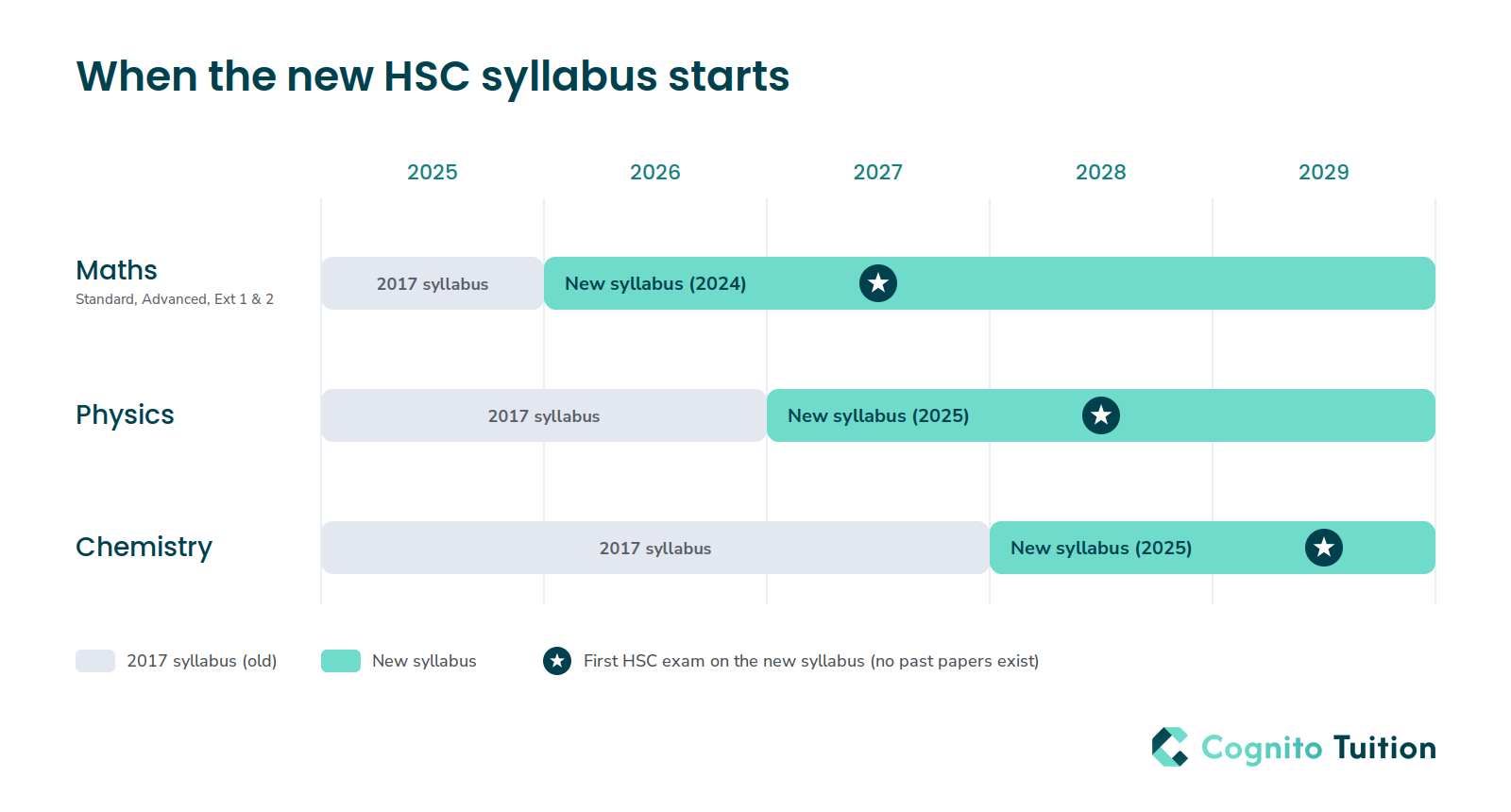
- Maths (Standard, Advanced, Extension 1 and 2): Year 11 started the new course in 2026. First new HSC exam in 2027.
- Physics: Year 11 starts the new course in 2027. First new HSC exam in 2028.
- Chemistry: Year 11 starts the new course in 2028. First new HSC exam in 2029.
In NSW, the Year 12 course begins in Term 4 of Year 11, not in the new calendar year. So students who started Year 11 in 2026 move onto the new Year 12 maths course in October 2026.
Are you affected?
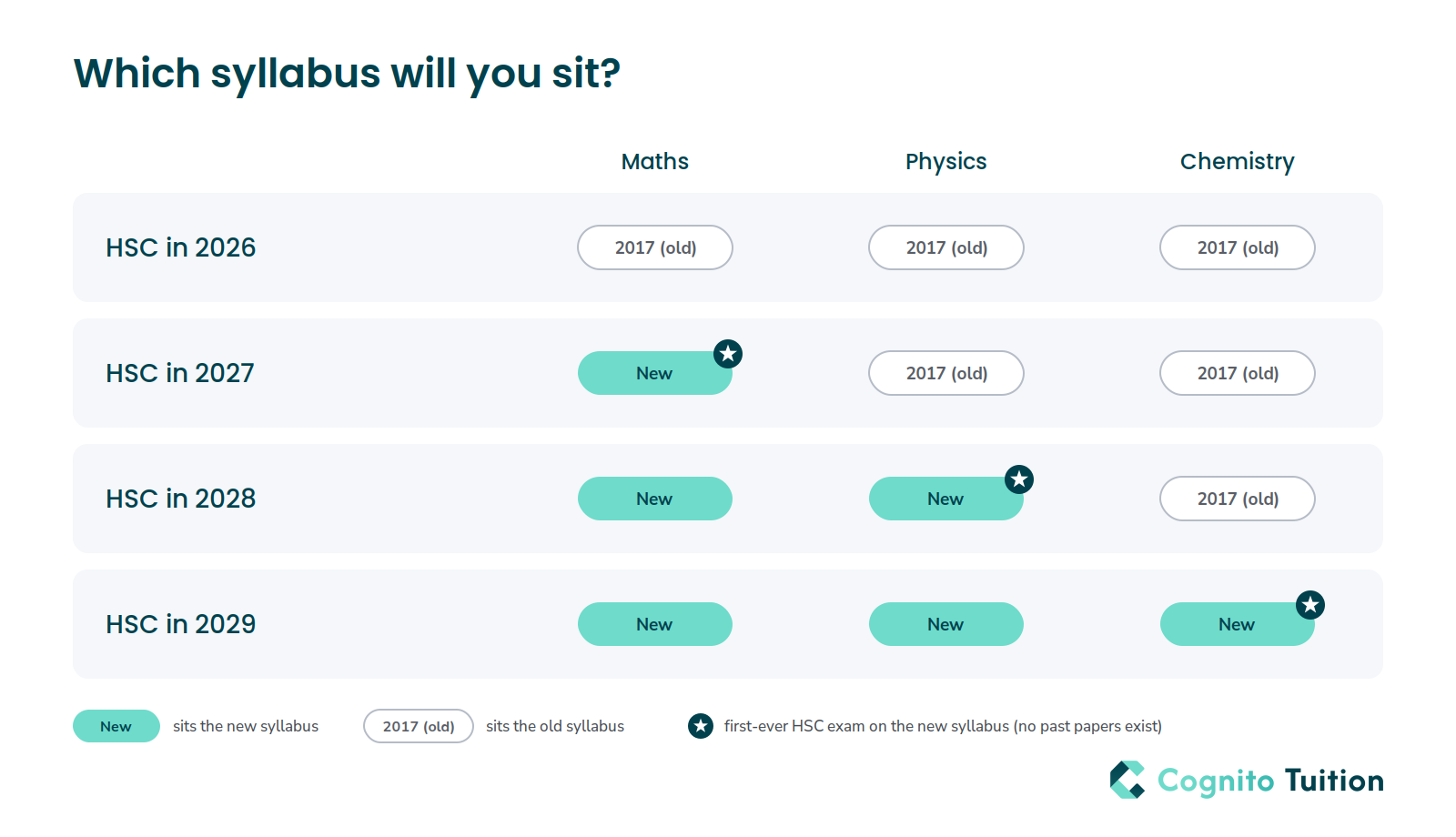
- HSC in 2026 (Year 12 in 2026): not affected. Everything stays on the old syllabus.
- HSC in 2027 (Year 11 in 2026): new syllabus for Maths, and the first group ever to sit the new maths exams. Physics and Chemistry stay on the old syllabus.
- HSC in 2028 (Year 10 in 2026): new syllabus for Maths and Physics, and the first group to sit the new physics exams. Chemistry stays on the old syllabus.
- HSC in 2029 (Year 9 in 2026): new syllabus for all three subjects, and the first group to sit the new chemistry exams.
Accelerated students: go by the year you sit each subject's HSC exam, not your year group.
What is changing?
Maths (Standard, Advanced, Extension 1 and 2)
- Content has been reorganised so Advanced, Extension 1 and Extension 2 students no longer repeat the same material across courses.
- Some topics have been added, removed or moved between courses and between Year 11 and Year 12, so the order topics are learned in has changed.
- The shared questions that appeared in both the Mathematics Standard 2 and Mathematics Advanced HSC exams are being removed.
Physics
- The course has been reorganised from 8 modules into 7 focus areas: 3 in Year 11 (Fundamentals of mechanics; Waves; Electricity and magnetism) and 4 in Year 12 (Advanced mechanics; Electromagnetism; Nature of light; Matter, energy and the cosmos).
- Aboriginal and Torres Strait Islander Peoples' scientific knowledge and practices are now part of the course.
- There is more focus on applying concepts to real situations and less on the work of named scientists.
Chemistry
- The course has been reorganised from 8 modules into 7 focus areas: 3 in Year 11 (Properties and structure of matter; Quantitative chemistry; Chemical reactions) and 4 in Year 12 (Equilibrium; Acid base reactions; Organic chemistry; Applying chemical ideas).
- There is more focus on applying concepts to real-world scenarios, particularly the industrial applications of chemistry.
- Year 11 now includes additional content highlighting the contributions made by important scientists.
Why this matters for study resources
Almost every HSC resource available today, including textbooks, study notes, question banks and every past paper, was written for the 2017 syllabus. For the first students to sit each new exam, there are no past HSC papers at all.
Because content has been added, removed or reorganised a student studying off old notes or past papers will end up studying the wrong content and wasting a lot of time.
The same applies to tutoring. Most tutors learned the subject under the old syllabus, and have not been trained on the new syllabus. Some centres will also keep using the materials they already have.
3 questions to ask any tutor or centre (including us)
- "Which syllabus are your materials written for?" Make sure the materials are written for the new syllabus, not recycled from the old syllabus.
- "What exactly changed in this subject and year?" Anyone teaching the new course can name topics that were added, removed or moved.
- "With no past papers, what will students practise on?" Look for practice exams written for the new course and the new exam format.
3 red flags that you are using an old syllabus resource
- It is organised by "modules". The old Physics and Chemistry syllabuses were built around Modules 1 to 8. The new ones use focus areas. A booklet with "Module 5" on the cover was written for the old syllabus.
- It includes old syllabus content. Be especially familiar with the topics that have been added or removed from each syllabus. A resource that has a focus on Thermodynamics in physics was written for the old syllabus as that topic has been entirely removed.
- It includes past paper questions. For the first students to sit a new exam there are no past HSC papers. If a resource is using past paper questions, it was likely recycled from the old syllabus.
How Cognito has prepared
Rather than patching old materials, our team rebuilt every course for the new syllabus from the ground up. Over the past year we have compared the old and new syllabuses dot point by dot point, rewritten all of our course materials and revision notes from scratch, and written new practice exams for the new courses, because past papers do not exist yet.
It is the same teaching approach that has helped 3,000+ students across HSC Maths, Physics and Chemistry, now built for the syllabus you will actually be examined on. It is the standard that supported 14 of our students in achieving the top ATAR of 99.95 in 2025 alone.
Not sure what the change means for you? Talk to our team and we will walk you through it, no obligation.
Stay tuned for more blog posts about the new syllabus!
Frequently asked questions
Does the new syllabus affect current Year 12 students?
No. Students sitting the HSC in 2026 finish entirely on the old (2017) syllabus in Maths, Physics and Chemistry.
Are there past papers for the new syllabus?
No. The first students in each subject sit an exam that has never run before. NESA has published sample exam materials for the new maths courses, and practice exams written specifically for the new courses are the closest substitute.
Is the new syllabus harder?
It is not designed to be harder! NESA describes the new courses as clearer and more streamlined, with less-essential content removed. The real challenge is uncertainty: the first students have no past papers, so preparing with materials written for the new course matters more than usual.
Can old past papers and notes still be used?
Only with care. They are still useful for topics that carried over unchanged, but content has been added, removed and moved between years, so old materials should not be the main resource.
Where can I read the official new syllabuses?
They are free and publicly available on the NSW Curriculum website: Mathematics, Physics and Chemistry.
Sources
- NESA: Curriculum Reform timeline
- NESA: Mathematics Advanced 11–12 Syllabus (2024)
- NSW Department of Education: Mathematics Advanced 11–12 Syllabus (2024), what has changed
- NESA: Physics 11–12 Syllabus (2025)
- NSW Department of Education: Physics 11–12 Syllabus (2025), what has changed
- NESA: Chemistry 11–12 Syllabus (2025)
- NSW Department of Education: Chemistry 11–12 Syllabus (2025), what has changed